✦ Published
BrockhouseCorgi1949
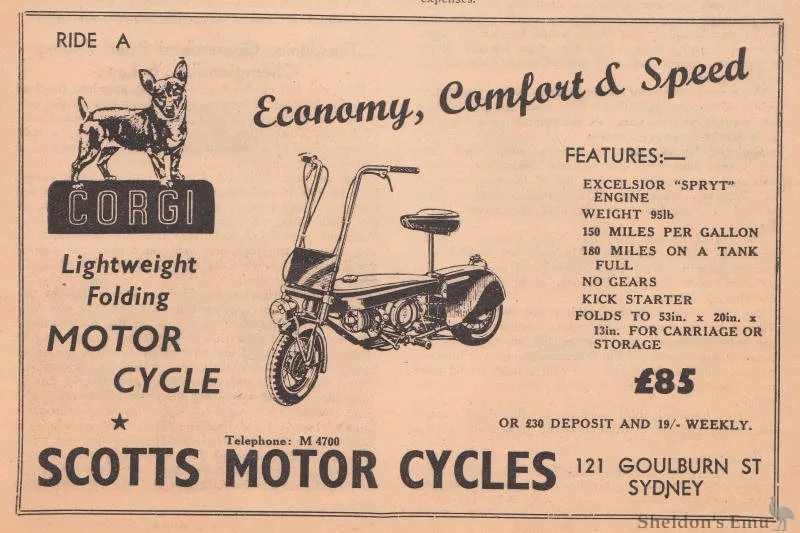
The 1949 Brockhouse Corgi represents a fascinating chapter in post-war personal transportation, emerging from the ashes of wartime utility. Born from the Welbike paratrooper motorcycle, the Corgi was designed to offer affordable and accessible mobility to the masses in an era of rationing and rebuilding. It carved out its niche in the burgeoning lightweight motorcycle segment, competing directly with other minimalist offerings such as the Excelsior Consort and the Francis-Barnett Powerbike, all vying for the attention of a public eager for individual transport.
At the heart of the Brockhouse Corgi was its humble yet effective 98.0 ccm (5.98 cubic inches) engine. This compact powerplant was engineered for reliability and fuel efficiency rather than outright speed. With a top speed of 56.3 km/h (35.0 mph), the Corgi was clearly not built for high-speed touring but was perfectly adequate for local errands and short commutes. Its modest 4.73 litres (1.25 US gallons) fuel tank capacity underscored its role as an economical runabout, offering a practical range for daily use without frequent stops for fuel.
Riding the Corgi was a distinctly no-frills experience. Its lightweight construction and basic suspension, often comprising undamped springs, meant that the rider felt a direct connection to the road. The Corgi’s simple controls and upright stance made it an approachable machine for novice riders, prioritizing ease of operation over sophisticated handling. While it lacked the plush comfort of larger touring machines, its compact dimensions and agile nature made it surprisingly maneuverable in congested urban environments, a key factor for its intended use.
The Brockhouse Corgi primarily targeted individuals seeking economical and straightforward personal transport. This included post-war commuters, tradesmen needing a nimble vehicle for local travel, and anyone looking for a low-cost alternative to public transport or a second family vehicle. Its utilitarian origins and minimal fuss design made it a practical choice for those who valued function above all else. In conclusion, the Corgi was a pragmatic solution for its time, a testament to ingenious simplicity in an era of scarcity, delivering essential mobility to a recovering nation.
✅ Why buy this bike?
• Extremely lightweight at 125 lbs, making it easy to maneuver and push around. • Excellent fuel economy from its 98cc engine, ideal for post-war rationing and cheap transportation. • Simple Villiers 1F engine is renowned for reliability and ease of home maintenance. • Compact folding design allowed it to be stored in small spaces or transported in a car boot. • Low seat height and automatic clutch made it very approachable for new riders. • A unique piece of British motorcycling history, appealing to collectors and enthusiasts.⚠️ Things to consider
• Top speed around 30-35 mph, unsuitable for modern traffic or longer journeys. • Minimal suspension offered a very harsh ride, especially on rough post-war roads. • Limited braking power from drum brakes, requiring careful anticipation in traffic. • Single-speed transmission restricted versatility and hill-climbing ability. • Small wheels and low ground clearance made it vulnerable to potholes and road debris.Rule of thumb: under 125cc / 15HP → A1, under 47HP → A2, above → A.
Estimated average for 98cc class: 75-100 mpg (2.5-3.5 L/100km)
⛽ Tank: 4.73 litres (1.25 US gallons)
Insurance grouping for BrockhouseCorgi1949 (98cc):
Personalised premium estimate for the BrockhouseCorgi1949 (UK rates):
💡 Estimate based on UK market averages. For real quotes, compare on Compare the Market, MoneySuperMarket, GoCompare.
Find new and used BrockhouseCorgi1949 listings:
💡 Third-party listings. MotoBike Info is informational only.
No comments yet. Be the first to write one!