✦ Published
Clarke Tricycle
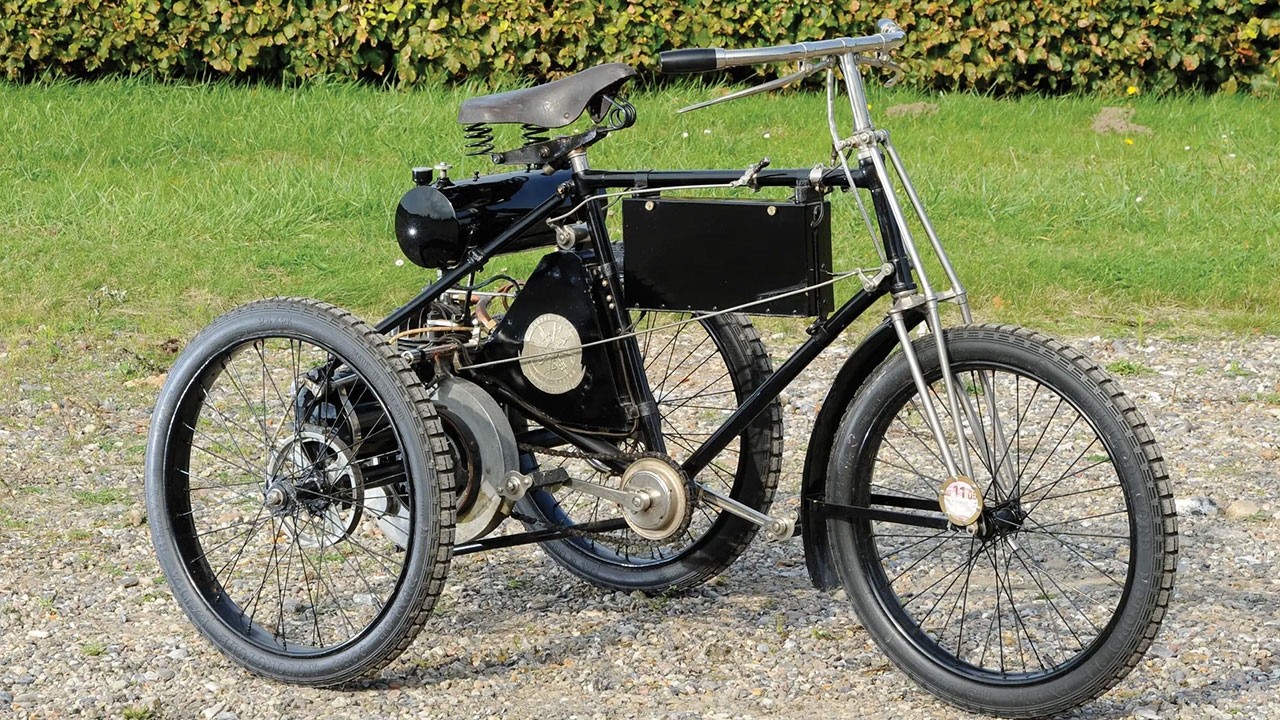
The Clarke Tricycle, emerging in the nascent years of motorized transport, represents an intriguing chapter in early motorcycle development. This three-wheeled machine wasn't designed to compete with the evolving two-wheeled motorcycles of its era, but rather to offer a stable, accessible form of personal locomotion. Its lineage traces back to the experimentation with internal combustion engines powering modified bicycle frames, a common practice in the late 19th and early 20th centuries. Direct competitors would have included other early tricycles and quadricycles such as the De Dion-Bouton tricycles or rudimentary motorized quadricycles, all vying for a segment of the market seeking simple, reliable personal transport.
Powering the Clarke Tricycle was a modest engine, displacing 138.0 ccm (8.42 cubic inches). This single-cylinder unit, typical for the period, was designed for practicality rather than outright speed. With such a displacement, one can infer a very gentle power output, likely measured in single-digit horsepower. Its purpose was to provide sufficient torque to propel the tricycle at leisurely speeds, making short journeys and navigating unpaved roads a less strenuous affair than pedaling. The engine's simplicity would have also contributed to its reliability, a crucial factor in an era where roadside assistance was non-existent.
Riding characteristics of the Clarke Tricycle would have been defined by its three-wheeled configuration. This offered inherent stability, a significant advantage over early two-wheelers which often demanded considerable rider skill. The upright stance of the rider, seated much like on a bicycle, would have provided a commanding view. Controls would have been rudimentary, likely involving a hand lever for throttle and perhaps a foot pedal for a basic brake. Comfort would have been minimal by modern standards, with perhaps a sprung saddle offering the only concession to bumps and vibrations from the simple frame and suspension-less design.
The Clarke Tricycle was clearly aimed at a pioneering audience – individuals seeking an accessible and stable form of motorized transport without the complexities or perceived dangers of early motorcycles. It catered to those who valued utility and ease of use over speed or sporting prowess. Its appeal would have been to a broader demographic, perhaps including those less confident on two wheels or requiring the extra carrying capacity a tricycle could offer. Ultimately, the Clarke Tricycle served as an important stepping stone in the evolution of personal mobility, paving the way for more sophisticated designs to follow.
✅ Why buy this bike?
• Three-wheel stability provides confidence for new riders and those with balance concerns on varied terrains. • Lower center of gravity enhances low-speed maneuverability and reduces fatigue during extended use. • Eliminates the need to put feet down at stops, ideal for urban commuting or frequent short breaks. • Increased cargo capacity compared to a two-wheeler, suitable for light hauling or shopping trips. • Simpler to learn and operate than a conventional motorcycle, lowering the barrier to entry for many. • The 138cc engine offers excellent fuel economy for daily errands and short-distance travel.⚠️ Things to consider
• The 138cc engine struggles with highway speeds and sustained uphill climbs, limiting long-distance touring. • Wider profile makes lane splitting impossible and filtering through traffic more challenging than a motorcycle. • Reduced lean angle compared to a two-wheeler, impacting cornering dynamics and sportier riding experiences. • Heavier than a comparable two-wheeled motorcycle, potentially affecting acceleration and overall agility. • Less agile and responsive in quick direction changes, making evasive maneuvers more difficult.Rule of thumb: under 125cc / 15HP → A1, under 47HP → A2, above → A.
Estimated average for 138cc class: 55-80 mpg (3.0-4.5 L/100km)
Insurance grouping for Clarke Tricycle (138cc):
Personalised premium estimate for the Clarke Tricycle (UK rates):
💡 Estimate based on UK market averages. For real quotes, compare on Compare the Market, MoneySuperMarket, GoCompare.
Find new and used Clarke Tricycle listings:
💡 Third-party listings. MotoBike Info is informational only.
No comments yet. Be the first to write one!