✦ publish
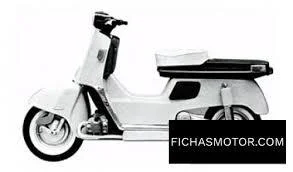
Honda Juno C 130
1963

1963
The Honda Juno C130, released in 1963, represents Honda's foray into the scooter market, a segment dominated by European manufacturers at the time. While not directly a motorcycle in the traditional sense, it offered a step-through design and enclosed bodywork, aiming to provide weather protection and ease of use. It competed directly with scooters like the Lambretta Li 125 and Vespa 150, seeking to capture a share of the growing personal transportation market with its unique features and Honda's reputation for reliability.
At the heart of the Juno C130 lies a single-cylinder, four-stroke engine with a displacement of 190.0 ccm (11.59 cubic inches). This powerplant produces a modest 6.5 HP (4.7 kW ) at 4800 RPM. The scooter's weight of 160.0 kg (352.7 pounds) contributes to its performance characteristics. While not built for outright speed, the engine provides adequate power for navigating urban environments and short commutes. The engine’s focus was on fuel efficiency and dependability rather than outright power.
The riding experience on the Juno C130 prioritizes practicality and rider comfort. The step-through design makes mounting and dismounting easy, appealing to a wide range of users. The enclosed bodywork provides some protection from the elements, enhancing comfort in less-than-ideal weather conditions. The seating position is upright and relaxed, designed for short to medium-distance rides. The scooter's suspension is tuned for comfort, absorbing bumps and imperfections in the road to provide a smooth ride.
The Honda Juno C130 was targeted towards individuals seeking a convenient and affordable mode of transportation, particularly those living in urban areas or suburban environments. Its ease of use and weather protection made it an attractive option for commuters and errand-runners. While not a high-performance machine, the Juno C130 offered a practical and reliable alternative to public transport or larger motorcycles. It can be seen as a precursor to the modern maxi-scooters, prioritizing utility and rider comfort over pure speed or handling prowess.
✅ Why buy this bike?
• Unique styling and design made it a standout scooter, representing a bold attempt at futuristic aesthetics for its time. • Advanced features like electric start and turn signals were uncommon for scooters of that era, adding convenience. • Fiberglass reinforced plastic (FRP) body panels offered improved durability compared to traditional metal scooter bodies. • Relatively smooth ride quality due to its torsion bar suspension system, providing better comfort on rough roads. • The 190cc engine offered adequate power for city commuting, making it practical for daily use in urban environments. • Shaft drive minimized maintenance compared to chain-driven scooters, reducing the need for frequent adjustments and lubrication.⚠️ Things to consider
• Complex mechanical design and limited production numbers made parts difficult to source and repairs challenging. • The FRP body panels, while durable, were prone to cracking and difficult to repair authentically, affecting restoration. • The electric starter system, while innovative, was known to be unreliable, leading to starting issues and frustration. • The Juno's unconventional design and relatively high price contributed to its commercial failure, limiting its long-term appeal. • The torsion bar suspension, while comfortable, could be prone to wear and difficult to service due to its complexity.The Honda Juno C 130 produces 6 HP, fitting A2 license limits (max 35 kW / 47 HP). For riders 18+.
Estimated average for 190cc class: 55-80 mpg (3.0-4.5 L/100km)
Insurance grouping for Honda Juno C 130 (190cc):
Personalised premium estimate for the Honda Juno C 130 (UK rates):
💡 Estimate based on UK market averages. For real quotes, compare on Compare the Market, MoneySuperMarket, GoCompare.
Find new and used Honda Juno C 130 1963 listings:
💡 Third-party listings. MotoBike Info is informational only.
No comments yet. Be the first to write one!